
30. April 2026
14th April 2026 | Why Do I Feel Like I’m Not Good Enough? |CBT for Low Self-Esteem: How Your Thoughts Shape Your Confidence
If you’ve ever found yourself thinking “I’m not good enough” you’re not alone. This belief can show up in subtle ways - second-guessing yourself at work, comparing yourself to others, or feeling like a fraud even when things are going well.
What’s important to understand is this: that feeling doesn’t come out of nowhere. From a Cognitive Behavioural Therapy (CBT) perspective, it’s usually the result of deeply ingrained thinking patterns, not an objective truth about who you are.
That sense of “not being enough” is often rooted in how your mind has learned to interpret your experiences over time.
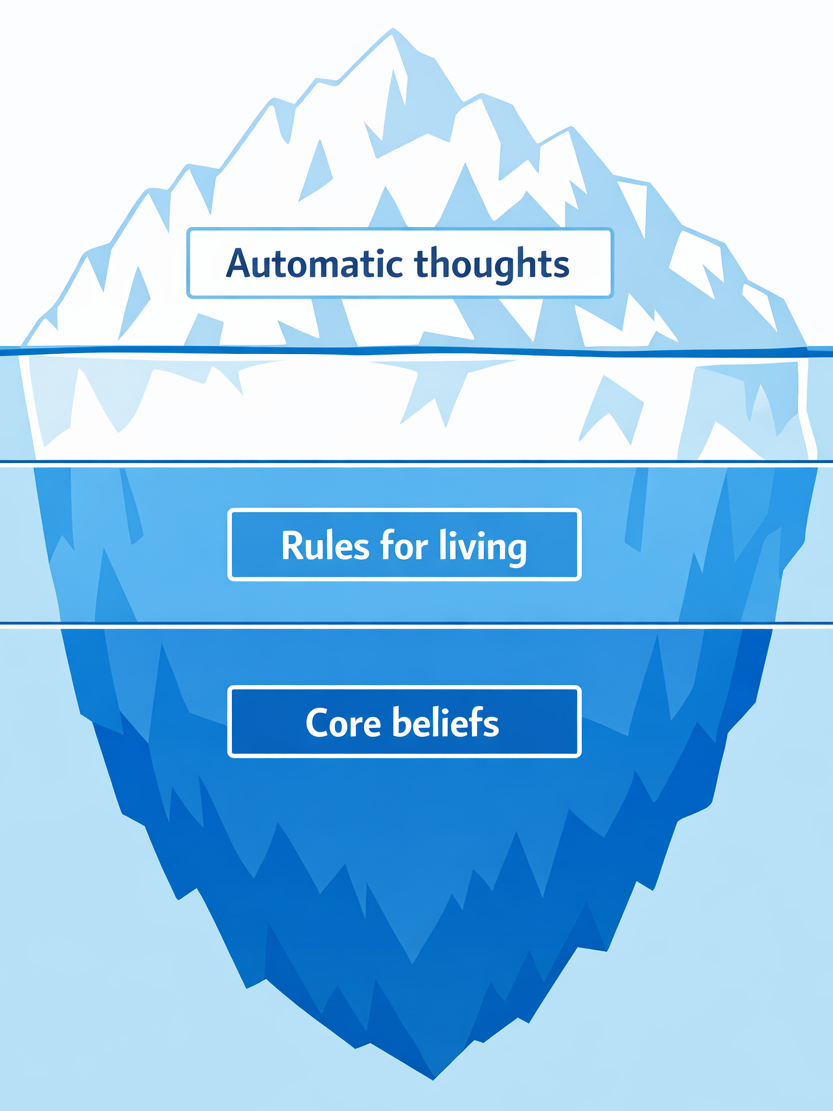
In CBT, we often understand this through three levels of cognition:
- Core beliefs (deep, underlying assumptions about yourself, the world and other people)
- Rules for living (the strategies you develop to cope)
- Negative automatic thoughts (the moment-to-moment thoughts you notice)
These layers are connected and they’re usually shaped by earlier life experiences. I often use an iceberg to demonstrate these layers as the negative automatic thoughts are above the surface and what we are consciously aware of on a day to day basis. The remaining two levels are below the water level, as we are often less aware of these.
1. Core Beliefs: The Foundation
Core beliefs are the deepest level. They are broad, emotionally charged beliefs about yourself, such as:
- “I’m not good enough”
- “I’m unlovable”
- “I’m a failure”
These often form early in life through experiences like:
- Repeated criticism
- Bullying or rejection
- Feeling compared to others
- Lack of validation or emotional support
Over time, your brain treats these beliefs as facts - even though they’re interpretations.
2. Rules for Living: How You Cope
To manage painful core beliefs, you (often unconsciously) develop rules for living; guidelines that help you avoid triggering those beliefs.
For example, if your core belief is “I’m not good enough” your rules might be:
- “I must not make mistakes”
- “I have to please everyone”
- “I should always appear confident”
- “I need constant reassurance to feel okay”
These rules can help in the short term, but they often come at a cost:
- Perfectionism
- People-pleasing
- Avoidance of challenges
- Burnout
They keep the core belief alive because they’re based on the assumption that it’s true.
3. Negative Automatic Thoughts: The Day-to-Day Experience
These are the thoughts you notice in everyday situations. They pop up quickly and feel believable:
- “I’m going to mess this up”
- “They think I’m incompetent”
- “I shouldn’t have said that”
These thoughts are shaped by your rules and core beliefs.
How They All Feed Into Each Other
These three levels don’t operate separately, they form a cycle:
- Core belief: “I’m not good enough”
- Rule for living: “I must be perfect to be accepted”
- Situation: You make a small mistake at work
- Automatic thought: “I’ve messed everything up”
- Feeling: Anxiety, shame
- Behaviour: Overworking, avoiding feedback, or withdrawing
This behaviour then reinforces the original belief: “See? I am not good enough.”
Over time, this loop strengthens, making the belief feel even more “true.”
How Your Thoughts Shape Your Confidence
CBT is based on a simple but powerful idea:
Your thoughts influence your feelings, which influence your behaviour.
If your automatic thought is “I’ll probably fail” you’ll likely feel anxious—and either avoid the situation or approach it with low confidence. That outcome then reinforces your belief.
This is why confidence isn’t just about willpower—it’s about how your mind is interpreting events.
How CBT Helps You Break the Cycle
CBT works by gently intervening at all three levels:
1. Working with Automatic Thoughts
You learn to:
- Notice them
- Question them
- Replace them with more balanced alternatives
2. Challenging Rules for Living
You begin to test assumptions like:
- “Do I really have to be perfect?”
- “What happens if I don’t please everyone?”
This often involves behavioural experiments; trying new ways of responding and observing the outcome.
3. Reshaping Core Beliefs
Over time, as you gather new evidence, your deeper beliefs can shift:
- From: “I’m not good enough”
- To: “I have strengths and weaknesses, like anyone else”
This is a gradual process, but it’s where lasting change happens.
Small CBT-Based Exercises You Can Try
- Thought record: Write down a situation, your automatic thoughts, and a more balanced perspective
- Spot your rules: Notice “should,” “must,” or “have to” statements in your thinking
- Test a belief: Gently do something your rules normally prevent and observe what actually happens
- Collect evidence: Keep track of moments that contradict your negative beliefs
When to Consider Therapy
If the feeling of “not being good enough” is persistent or affecting your work, relationships, or daily life, working with a CBT therapist can help you go deeper.
Therapy provides a structured way to:
- Understand how your beliefs developed
- Break unhelpful patterns
- Build a more stable sense of self-worth
Feeling like you’re not good enough can be incredibly convincing, but it’s not a fixed truth. It’s a pattern shaped by your experiences, and maintained by the way your thoughts, rules, and beliefs interact.
And patterns can change.
With the right support and strategies, you can begin to relate to yourself in a more balanced, compassionate, and realistic way. That’s where genuine confidence starts.